
Windrush survivors and victims of Earned Settlement warn MPs: ‘Stop the scandal before it happens’
On 14 September, a panel of Windrush survivors, health and care workers urged the government to stop history from repeating itself, and put an end to the Earned Settlement proposals.
The Earned Settlement proposals are needlessly punitive. Among other elements, they would double the qualifying period for settlement for most migrants, from five years to 10. Care workers and others in so-called “low skilled” jobs would face triple the time period with a wait of 15 years. Refugees and other groups may wait as many as 20 years before they can apply to settle. Indeed, with a plan to add additional years for claiming public funds or overstaying, some people may never be able to settle in the UK.
Time and again, civil society has warned ministers against the harms of these proposals, which are set to affect more than two million people. If implemented, the Earned Settlement measures are likely to increase poverty, heighten the risk of labour exploitation by tying migrants to their employers for decades, and deepen racial inequality.
As ministers are expected to implement these proposals this autumn, we assembled a powerful new coalition of health, care and racial equity groups to tell MPs in no uncertain terms that we have seen the devastating impact of poorly thought out immigration policies before with Windrush. We have seen how policies purportedly designed to achieve “integration” led to shameful racial inequality once implemented, and how radical measures created without an impact assessment can ruin people’s lives.
Labour enthusiastically accepted the recommendations of the Windrush Lessons Learned report, then appears to have forgotten that pledge. We gathered in Westminster to remind MPs of that, and to urge them to stop Earned Settlement before it becomes another national scandal.
Four speakers explained these parallels through their own stories of hardship and heartbreak due to cruel immigration policies.
Windrush and Earned Settlement: A Living Legacy
Bell Ribeiro-Addy MP opened the event with remarks highlighting the suffering of the Windrush generation. She stressed the human impact of ill-designed immigration policy and reiterated her commitment to ending the Earned Settlement proposals.
“The Windrush scandal is not a historic event when its racist legacy lives on through policy proposals like Earned Settlement, which have already cast a long shadow over the NHS and the adult social care sector.
These proposals risk perpetuating the same harms inflicted on the Windrush generation and continuing that legacy of broken promises and institutions. The government should drop them and commit to pursuing a fair and just immigration policy."
- Bell Ribeiro-Addy, Labour MP for Clapham and Brixton Hill
The first speaker was Glenda Caesar, a Windrush victim and former NHS/GP practice administrator. In 1961, she arrived in the UK from Dominica as a three-month-old child. Glenda believed she was British because the UK was the only home she had ever known.
Decades later, she was denied a passport and was sacked from her position in the NHS because she could not prove her right to work. And, because she was believed not to be a British citizen, she was not eligible for benefits and was forced to rely on her children for support. At her lowest point and on the verge of destitution, Glenda even contemplated suicide to avoid being a burden to her children. Instead, she has chosen to fight.
"I see with the earned settlement policy, this covers the same sort of things that our children are having to go through... We still need legal support because there's legislation that they are putting in front of us and trying to change the goalposts for the victims."
- Glenda Caesar
Like Glenda, Deborah Trotman, a Windrush campaigner whose mother had arrived in England as a nurse at the birth of the NHS, described her family being torn apart by sudden changes in immigration policy. Her brother, a British citizen by right but not on paper, was forced to leave the UK or be deported to Barbados.
Beyond the many nuances of every painful personal experience, Glenda and Deborah warned against the unintended harms of immigration policy which catches both the vulnerable and the innocent. As many as 90,000 children of migrant workers raised in Britain risk falling into poverty if the Earned Settlement policies are implemented, according to analysis commissioned by the No Recourse to Public Funds Partnership.
This impact does apply to everyone equally. The child of a banker earning over £125,140 would be granted a three-year route to settlement, while the child of a care worker faces a 15-year route. Some British children may spend their entire early lives with parents on a 30-year route, or a parent who has no prospect of settling at all.
Hearing the stories of those affected by Earned Settlement reminded Deborah of her own family’s struggle. She warned that this heartbreak was avoidable, and called on the government to stop the Earned Settlement proposals so that future families do not need to suffer decades of devastation, like hers did.
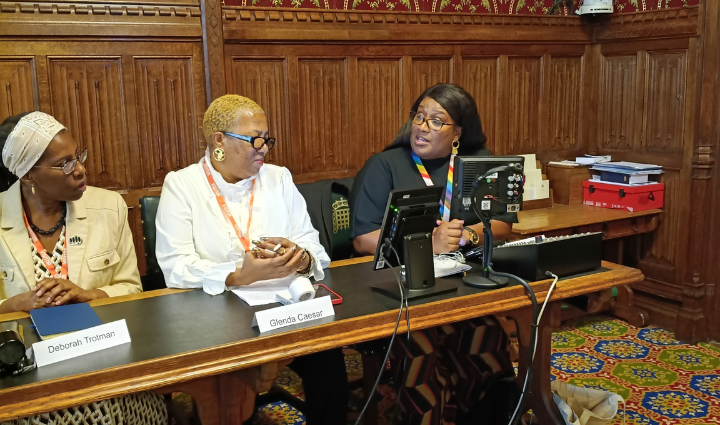
Panelists Deborah Trotman, Glenda Caesar and Bell Ribeiro-Addy MP at the Westminster event
‘Putting our lives on the line’ - Health and Care workers
Two further speakers directly impacted by the Earned Settlement proposals warned the changes to ILR could have a drastic impact on the NHS on top of the individual risk to migrants.
Paul Awah, an NHS radiographer from the Midlands, laid out how the proposals will affect allied healthcare professionals including doctors, nurses, cleaners and lab technicians, right through to healthcare support workers and social care workers – all critical pieces of the NHS, health and care ecosystem.
"Without the contributions of expatriates, whom you call migrant workers, the NHS will collapse. You don't know what you have until you’ve lost it."
- Paul Awah (NHS radiographer)
Paul expressed his frustration with how internationally recruited workers already pay significant fees to renew visas and to settle in the UK. He explained how these same workers provide essential services and risked their lives in the COVID-19 pandemic. He described the fear of going to work every day with his wife (who also works in the NHS) and not knowing if they’d return home. But now, the same people who were once clapped and shown gratitude, are labeled as an inconvenient legacy, dubbed the ‘Boriswave’.
Care workers are the specific target of that label. Ene* (given a pseudonym), who arrived in 2022 is a year away from qualifying for indefinite leave to remain, but the proposals would triple that wait. For himself and his young family, the proposals are a betrayal.
Ene described the difficulties within the care sector. Working in 12-hour shifts with no breaks, he was forced to take on multiple roles: as kitchen assistant, medical assistant, performing technical tasks and caring for residents, including after they died.
Ene was one of three workers responsible for 42 residents in a facility which charged its clients £1,800 per week – but was told many times they could not afford to hire more staff. Eventually management capitulated and hired one extra worker, leaving four people to care for 42 vulnerable residents.
Speaking up for residents required significant courage, given the power imbalance underpinning Ene’s visa. Sponsors have the power to ‘curtail’ their visa, leaving them without a valid immigration status. By extending the qualification period to 15 years, workers would be bound to years of sponsored work, and thus become exponentially vulnerable to exploitation. If this is how the government plans to tackle the crisis of recruitment and retention in the care sector, Ene warned, it would come at the cost of a permanently precarious migrant workforce.
“The care crisis is impending, with massive shortages and trying to fix the care crisis by keeping migrants in the roles for as long as possible. Many NHS patients cannot be discharged, and with an aging population there will only be more and more need for carers.
But the Earned Settlement policy is not the solution. This policy does not show faithfulness and is moving the goalposts in the middle of a match. If we thought it would be changed, who would be willing to play the game at all?”
- *Ene (Care worker)
Every speaker brought a human face to policy choices. Each has a family. Ene and Paul spoke of their children’s anxiety: born to a British home but not allowed to belong. This theme was key to both Deborah and Glenda’s stories, in how quickly and cruelly policy can divide families and drive personal suffering. Furthermore, fear and anxiety builds from the uncertainty, both in resolving Windrush compensation and with the looming Earned Settlement implementation date. For Earned Settlement, while the policy is set to be introduced in ‘Autumn 2026’, there is no indication of when (or what) the government will deliver.
Overall, the event showcased stories connected through time and across this country – by the past and future harms of hastily designed immigration policy, passed or announced without much-needed impact assessments. Much is needed to atone for the past, but this event spoke about how people can join together to prevent the same harms from recurring in the future.
The message was clear: to honour the spirit of Windrush the government must learn its lesson and stop the Earned Settlement proposals from becoming the next devastating scandal.