
Liberal Democrats party conference 2026: Compassion without Commitment
The Liberal Democrats introduced their party conference with a theme: Why we care, why we fight.
Speakers stuck to a theme of reaching out to communities and building opportunity while standing up to far-right threats. But at a conference which promised progressive liberalism, there was a glaring policy omission: migrant workers’ rights.
At last year’s conference, migration was a key issue. But this year, immigration was only obliquely referenced in major speeches and almost exclusively brought up to oppose the threat of Reform’s policies. At a time when the Labour government is proposing historic reforms to the immigration system, spurred on by Reform’s increasingly anti-migrant narratives, the absence was pronounced. There were no substantive policy proposals for migrant workers (or workers at all). Instead, only two fringe events raised issues of migration: one on the Refugee convention / asylum system and the other on integration within communities. Meanwhile, no events raised working conditions or employment justice.
The Work Rights Centre and other allies in the sector made our best efforts to raise migrant workers’ issues in sessions. But the Liberal Democrats wholly missed the opportunity to make their mark with meaningful policy.
Takeaways from Keynote Speeches
The opening conference rally featured a range of party speakers, from councillors to MPs, who explained their journey to the Liberal Democrat party. Some came from working class backgrounds and spoke about families working hard to get less. One councillor described their family history with a grandparent seeking asylum. Each speaker set the tone by preaching compassion and social justice, while also being ‘up for the fight’ and having the ‘backbone’ to take on populism.
By the time leader Ed Davey appeared on stage to a crescendo of applause, his own origin story was less of a directive and more a biting condemnation of Reform. He recalled his own university days in the apartheid era and the urge to stand up to injustice. He called out Reform’s politics of division, and promised the Liberal Democrats would stand up to the rising tide of the regression of rights.
Further keynote speeches took on this theme, including Treasury Spokesperson and deputy leader Daisy Cooper MP promising to deliver growth to defeat the far-right. Her speech centered around creating economic growth to build better communities because economic opportunities breed social acceptance. At a key moment in her speech she declared: ‘Wealth creation and social justice are two sides of the same coin’. However, these promises were seemingly aimed at employers instead of the employed.
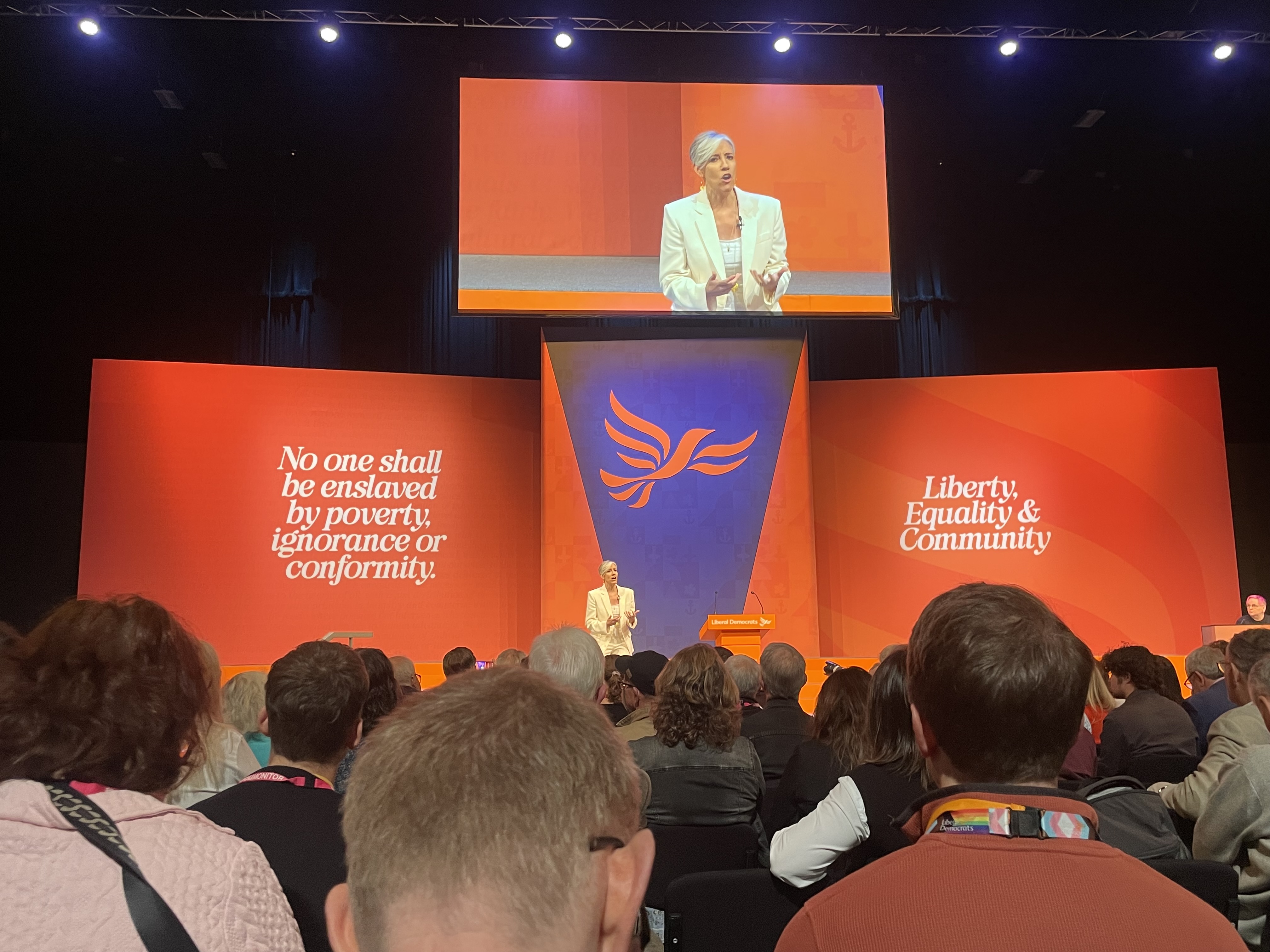
Daisy Cooper presenting at the 2026 Liberal Democrats party conference
Both her speech and economic plan (published contemporaneously to her remarks) fail to address the rights of migrants or workers. Her plan only contains one broad commitment to maintaining strong workforce protections. Whereas Labour has brought workers’ rights and the Make Work Pay agenda to the fore, the Liberal Democrats’ lack of policy commitment around worker welfare is an oversight. Further, the absence defeats the promise of socially just wealth creation.
Another key speaker was Max Wilkinson MP, the Liberal Democrat Home Affairs spokesperson. He was vocal in opposing anti-migrant narratives in his speech. He too called out the growing influence of Reform and went as far as to challenge his counterpart Zia Yusuf to a debate on migration policy. Wilkinson promised a fair and secure asylum system both in his speech and at a fringe event reflecting on the 75 years since the 1951 Refugee Convention. However, he failed to take a position against the Earned Settlement proposals, a key point in Labour’s current immigration policy.
Wilkinson did make some substantive policy proposals, but these failed to capture migrant worker issues. For example, he used the opportunity to reinforce support for the ECHR. He pointed out that Reform intends to oppose migration through removing rights from everyone in the UK. Furthermore, his biggest policy announcement was about a levy to fine Big Tech companies. While both points are important, it was again a missed opportunity for the Liberal Democrats to make their mark in a critical area. It also continued a pattern of the party failing to explain its vision of fair immigration policy.
Focus on Health and Care Workers
In our experience of the conference, one of the clearest statements related to immigration policy came from a Health and Care Q&A. In an open forum, Helen Morgan MP and Baroness Pidgeon addressed a range of issues from single patient records to the NHS Workforce Plan and the appointment of a National Maternity Coordinator.
We specifically asked about their thoughts on migrant worker welfare within plans for the sector in the context of the rising recruitment and retention crisis — due to insufficient domestic supply and international workers facing hostile environment policies and dangerous working conditions.
Helen Morgan MP addressed the question clearly: acknowledging that the domestic labour market for carers is inadequate, but that international recruitment of care workers has been an imperfect solution. She specifically described her experience of supporting exploited care workers within her constituency, and how that trend indicated the current system’s failings.
She further stated that she found the current Earned Settlement proposals ‘not fair’, particularly opposing retrospective application of the rules because the government was ‘pulling the rug out from under people’. Finally, she said that recruitment and retention issues were severe and steps needed to be taken to model data and better understand the current (and future) service gap, as well as to investigate solutions to address the growing lack of access.
At a fringe event by Citizens UK called ‘Rooted and Recognised: How to create welcoming and inclusive communities’, a core topic was care workers and immigration policy. An explanation about the cruelty of the Earned Settlement proposals was paired with the impact of rising Home Office sponsorship revocation and displaced workers. A panel of civil society and policy individuals from the3million, Tresacare and Asylum Welcome described issues alongside Lord German.
The conversation ranged from stories of lived experience to the meaning of integration within communities, looking at policy examples from Scotland that prioritise acceptance over assimilation.
Speakers delivered final messages to politicians: ‘Care about the care sector’ and ‘Integration is a two way process, a commitment not just from the migrant but the government and community’.
Elizabeth Alake-Akinyemi, a Colchester City Councillor, began her remarks with the idea that immigration policy has disappeared from community discussion. She said that many councillors found it ‘safer to be quiet on the issue of immigration to avoid falling out of favour with voters’.
That sentiment felt widely applicable to the conference at large. One can only speculate over why the Liberal Democrats failed to put immigration policy at the heart of their action plan. It is unclear why they made the ‘safe’ play: if they dropped the ball or chose to sit on the sidelines. But for a party who repeatedly committed to taking on Reform and highlighting Labour’s failings, this was an unforced error: missing the opportunity to make a mark on immigration policy and workers rights is missing an obvious trick.
We are glad to see that the Liberal Democrats are willing to fight. But fighting means embracing the difficult issues, not just making nods to social justice for the sake of maintaining liberal values. We hope the Liberal Democrats will return to their 2025 mindset (and Manifesto promises) to not only care, but to fight for migrant workers’ rights.