
Labour Party Conference 2026: Andy Burnham has noble ambition for care but it must include migrant care workers
As the trains packed with lobbyists rattled out of Liverpool Lime Street, you’d be hard pressed to find one who doesn’t agree about at least one thing: the Labour Party Conference this year was different.
The message of ‘hope again’ was beaming from every screen. Reform barely received a mention, and the sense of existential threat that clouded Fringe events last year had, for now at least, subsided.
There were good reasons for it too: Andy Burnham’s rousing speech and his ambitious plans for a National Care Service, marked a new dawn for care recipients and their families, and the energy of that new-found hope was palpable.
Closer to home, Sarah Sackman KC pledged to the Work Rights Centre to tackle the record-high backlog in Employment Tribunals, and work with us to find solutions. We wholly welcome the opportunity to work together to save the employment justice system.
"The clue’s in the title, we’re the Labour party. And if we can't get workers’ rights right, then we failed in our founding mission. I agree with you that the employment tribunal backlogs are a massive priority and be in no doubt, it is absolutely top of my in-tray next to Criminal Justice backlogs as well.
And what I say is work with us. I genuinely have an open mind about what solutions might strike the best balance between the modernisation of our court service, vindicating those rights, but also challenging the real-time issue, which is that if someone is waiting four years to resolve an employment dispute, that is shocking."
- Sarah Sackman KC, Minister for Courts and Tribunals
But, there was one glaring omission. It was painful to observe how migrant workers, who constitute about one in three direct care roles today, were completely absent from the Prime Minister’s speech and the many (many!) fringe events on the matter. Just one MP, Neil Duncan-Jordan bucked that trend, and we thank him for it.
Has this government forgotten that hundreds of thousands of care workers are tied to their employers on high-risk visas, and that the Home Office settlement changes could extend the tie for 15 years? Have ministers not heard employers bemoan sponsorship costs and complexity, and the many calls for visa reform? Just last year, their own Immigration White Paper recognised these risks.
The only Fringe event featuring the Minister for Migration, Jo White, was painfully familiar: tough rhetoric and tougher policy, almost as if it was plucked out of last year's agenda.
This disconnect can’t last. Andy Burnham may have made a conscious decision to keep migration out of his speech — and the headlines. But when the careforce depends on migrants, sooner or later he’ll have to come off the fence: change the direction of migration policy, or accept that his National Care Service will be delivered by a two-tiered workforce.
The hope for a National Care Service
To say that adult social care was on everyone's lips would be an understatement. We counted 20 Fringe events on the matter (compared to six on AI), and attended those that included the Home Secretary, Yvette Cooper, and her minister for social care, Alison McGovern.
If party conferences often blur into frenzied (and often soulless) lobbying, this time it was inspiring to hear the many impassioned speeches by professional adult social care associations, care users, families, charity leaders and MPs, many of whom had personal experience with England's complex, prohibitively expensive care system.
For some, a National Care Service was an opportunity to standardise the standard for care, and redress what Neil Duncan-Jordan aptly called the injustice of a system where some illnesses receive free care from the NHS, and others fall entirely on families to cover the costs.
For others, it was an opportunity to redress the trend of 1,500 adults who quit employment every day to care for a family member according to Carers UK, and spur economic growth.
Many speakers, including MP Anna Dixon, a GP, highlighted the role of adult social care in taking pressure off the NHS, and contributing to healthier, more independent lives.
Then, there was the workforce. Minister McGovern passionately called for care workers to be valued; not relegated to “low skill” status, but appreciated for their emotional intelligence. For too long, she said to supportive audiences, care workers have been taken for granted because they were “working class women”. Burnham's National Care Service would change that — including by introducing a Fair Pay Agreement, and tasking a cross-ministerial group with further workforce support measures.
“We have a big challenge ahead. We're going to all have to work together. But it starts from recognising who the people are who work in social care, the families that they care for, that shared interest between those people to make sure it goes well, and being so grateful, and so thankful for all the work they do.”
- Alison McGovern, Minister for Social Care
The migration exception
It was precisely that new sense of historic possibility that made the absence of any mention of migrant care workers and their struggles so jarring.
Surely, it is known that about one in three direct care workers is a migrant, as indicated by the latest data from charity Skills for Care. The 28% who are also non-EU nationals, and came to the UK on visas tied to employers, face well-documented labour and financial exploitation risks, and last year the Home Secretary threatened to extend that tie to as much as 15 years, as part of her plans to restrict routes to settlement.
For anyone who has avoided the news, UNISON, the largest union in the UK, held a visually striking protest outside the main conference, where workers bound by ball and chain left any passer by in no doubt: sponsorship is akin to bonded labour.
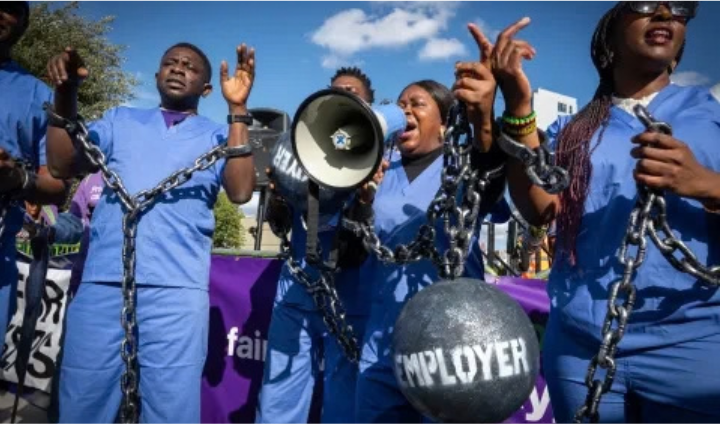
Image credit: Steve Forrest/UNISON.
So why the silence?
With the evident caveat that different speakers will have their own reasoning for not mentioning migrant workers, whether intentionally or not, there is too much at stake to shrug it off.
First, there was a striking lack of speaker diversity — not just ethnic diversity, but diversity of voice. None of the speakers at the events we attended represented the workforce, although Neil Duncan-Jordan made a pointed intervention at the Social Care Rally in support of migrant and all care workers.
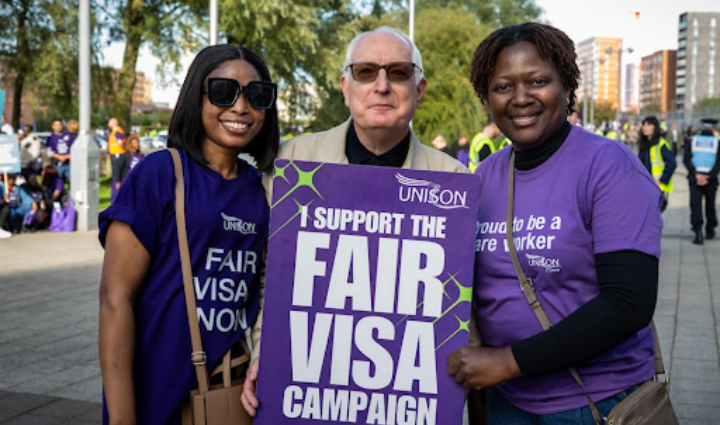
Image credit: provided by Neil Duncan-Jordan’s office.
Then, there is the overwhelming multitude, and technicality, of issues faced by migrant workers. It’s not just the risks inherent in sponsorship, but also restrictions to their right to bring dependents, restrictions on settlement and, most significantly, an alarming visa cliff edge in 2028.
The July 2028 Health and Care visa cliff edge
In July last year, the Home Office changed the immigration rules to (1) ban the international recruitment of migrant care workers and senior care workers under the Health and Care Worker visa; and (2) only permit the recruitment of those who were already in the UK for a transitional period, ending on 22 July 2028. As no further announcements have been made since, it is wholly unclear whether, and under what conditions, migrant care workers can continue working in the UK beyond that point. The Skilled Worker visa remains open in theory, but the minimum salary requirements under this route far exceed care sector salaries, making it wholly unworkable in practice.
For migrant care workers, this is life changing stuff. For care providers, it’s a near existential risk and the well-resourced ones are already turning to their lawyers for answers. For everyone else however, the 2028 visa cliff edge is technical, buried in complex immigration rules, and drowned out by Earned Settlement — another urgent, but radically different, issue.
When we asked Minister McGovern what the future for migrant care workers who face a cliff edge in 2028 looks like, she emphatically thanked them for their contribution, but noted that the Home Office’s response to settlement is upcoming. These are different problems, and their conflation shows just how much complexity migrant care workers, the sector, and the people covering it, have to keep up with.
“When you’ve got a workforce that is vulnerable and precarious in whatever way, that is not conducive to the quality of care that we want. I think people need rights at work because of that.
And I would just say that in this city in Liverpool, whether you support Liverpool or Everton, when you put the shirt on, you’re one of us. And if people come here, contribute to our country and work hard, particularly people who are looking for others, the words we are looking for are: thank you.”
- Alison McGovern, Minister for Social Care
Then, there is the politics
Beyond the technicality of immigration policy, it’s hard to shake the sense that the absence of migrant workers from plenary speeches was planned. Andy Burnham’s speech was deeply personal and moving, but it’s unlikely that in an intervention of this calibre, the omission of the migrant careforce was left to chance.
The Prime Minister’s team will likely have made a conscious calculation to say nothing on migration - not least because migration is one of those “top” public priorities, where the public’s perceptions remain frustratingly out of step with reality.
Instead, the only ministerial intervention related to migration was largely left to Jo White, the Minister for Migration and Citizenship. She joined a British Future Fringe event optimistically titled “Fresh Start: A Migration System That Works for Britain”.
There was little that rang fresh in the Minister’s comments on tough Home Office action, and tougher policy. The main novelty was her striking response to a journalist from The Times, who probed about the potential exclusion of care workers from the 15 year route to settlement. Did a Labour minister really mean to say we need to delay the settlement of migrant care workers to prevent them leaving the sector?
"I don't want us to get into that spiral where people move out of the care sector because they've got [indefinite] leave to remain,” White said, as reported by The Times correspondent Aubrey Allegretti.
Time for Burnham to get off the fence
The political calculation to say nothing on migration might make sense in the short term. A National Care Service is a major announcement that will no doubt trigger many questions about implementation, entitlements, and funding — particularly when the Prime Minister also announced changes to the pension triple lock.
Burnham’s other major proposal to forge a closer relationship with the EU will also likely have commentators speculating for months, given that few other topics in British life have been as polarising as Brexit.
But, sooner or later, his office will have to come off the fence on migration. This doesn’t mean talking more about it, but bringing migration policy in sync with this government’s strategic goals.
Currently, the disconnect between the National Care Service and Home Office policies (the 2028 visa cliff edge, employer sponsorship and Earned Settlement) is wholly unsustainable. For the sake of migrant care workers and care users, we hope this reconnection comes sooner.