
Green Party Conference 2026: A welcome, progressive agenda but no clear plans to improve workers’ rights
This year has been a strong one for the Green Party. While it is still on the fringes of Parliament with just five MPs, the party made strong gains in local elections. It increased the number of its councillors in England from 146 to 587, won five councils outright, and had two mayoral candidates elected in Hackney and Lewisham. The Green Party also presented voters with a progressive alternative, which manifested in them winning the Gorton and Denton by-election in February.
As expected, the party conference atmosphere in Brighton was optimistic about the future. Delegates discussed the next steps of a refreshingly progressive agenda, which party leader Zack Polanski hopes will make “Labour move” on its own positions. Among the flurry of topics discussed, there was almost no mention of workers’ rights. In this article, we discuss the importance of this omission, and the particular areas where Greens have a real opportunity to shift the policy conversation.
Workers’ rights – a peripheral issue for the Greens
After it launched a Workers’ Charter on May Day, we hoped the Green Party would push Labour towards further reform of employment rights. For example, the Charter specifically calls for a single worker status, which we support in principle.
However, the conference showed the party’s focus lies elsewhere. With the exception of fleeting references to the Maximum Workplace Temperature Bill, tabled by Hannah Spencer MP, neither Zack Polanski’s Friday speech, nor any other major events we attended made any reference to employment rights. Similarly, there was not a single dedicated panel discussion or fringe session.
Each of the five Green MPs has a large portfolio of Westminster policy, resulting in the prioritisation of some subjects over others. Environmental policy, for example, naturally comes first.
But employment rights matter. In their 2024 manifesto, Greens said they wanted to improve the quality of life for the average Briton, and increasing workers’ entitlements is integral to achieving this.
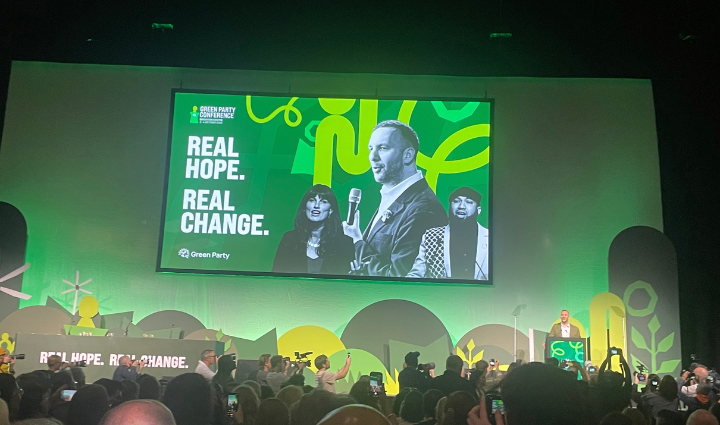
Zack Polanski speaking on stage
Greens can press Labour towards potential reform
It is difficult to challenge Labour on employment rights after it delivered the Employment Rights Act 2025, arguably the most expansive piece of legislation on the issue in a generation. Yet, despite its many positive contributions, the Act has oversights, which had been raised in parliamentary debates.
“Single worker status”. First is employment status, which the Green Party rightly identified as a focus area in its Workers’ Charter. The current framework determining which rights one has in the workplace is out-of-date, overly complex, and enables employers to misclassify staff to reduce their entitlements. We agree with the Greens that “single worker status” could simplify this framework and, coupled with other reforms, reduce the risk of exploitation.
The anticipated consultation on this issue is a great opportunity for the Green Party to direct the conversation and ensure workers will be able to access their new rights in practice. This requires a proactive approach and fine-tuning of what “single worker status” will mean in practice.
Employment Tribunal awards. Second is enforcement of Employment Tribunal awards. If workers cannot obtain the compensation they are awarded by a judge, then any new rights they have are weakened. However, The Bureau of Investigative Journalism revealed the government’s enforcement scheme has resulted in just 26% of claimants receiving the money they were owed between 2016 and 2025.
Although the Green Party does not have this as part of their Charter, there is scope to work across party lines to improve compliance with judgments. All five MPs signed an Early Day Motion earlier this year to address the issue of enforcement of Employment Tribunal awards, which needs a second wind. And experts in the field could be involved – some, like Industrial Law Society executive committee member Darren Newman, have called on the government to act.
Migrant workers. Finally, migrant workers need separate attention in policy conversations. While the conference had many supportive statements around migrants being welcome, there were no substantive policy proposals about migrant workers from the Greens. As we wrote in a 2023 report, migrant workers face systemic challenges to reporting abuse and standing up for their rights, which must be addressed through immigration system reform.
This is not easy, at a time when Shabana Mahmood is steamrolling restrictive immigration reforms through Parliament. However, there are also opportunities on the horizon, including the Home Affairs Select Committee’s new inquiry into work migration and the policy decisions that will be made off the back of it, as well as any concessions for migrant workers that the Home Secretary might make as part of her “earned settlement” proposals.
We hope the Green Party will engage with us and other stakeholders to offer a work migration model that protects migrant workers, rather than encourages exploitation.