
‘We are asking for our rights’: when lived experience met legislative power in Westminster
When the “earned” settlement model was first announced on 20 November 2025, it took a while for the magnitude of these plans to set in - for everyone. We immediately began to analyse the impacts the proposals would have on our clients. It soon became apparent they had both terrified and confused everyone they would affect.
We received a barrage of emails with questions that did not always have simple answers: ‘How will these proposals impact my children?’ ‘Will I be subject to the same penalties as my wife as is the main visa holder?’ ‘Will I be forced to return to a country where I am at risk of violence?’
Many MPs, it seems, were slow to realise the vastly convoluted, layered and punitive ways the proposals would affect their constituents. As mentioned by Steve Witherden, Labour MP for Montgomeryshire and Glyndŵr, some initially failed to see their significance beyond Ukrainians and Hong Kongers.
But for those of us working directly with migrant workers on the frontline of the UK’s increasingly hostile immigration environment, almost every day presented a new pernicious way that families would have their futures pulled from under them.
Fundamentally, these proposals increase the baseline waiting period for settlement: from five to 10 years for most people, 15 years for low-paid workers and carers, and as much as 20 years for refugees.
But on top of this, the government set out a complex system that calculates an individual’s “contribution” based on factors including method of entry into the UK, claiming benefits, and volunteering, with little detail on how this would work in practice or whether it was workable at all.
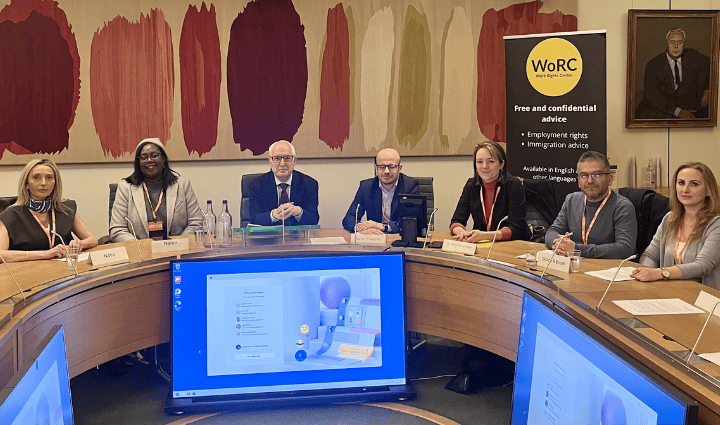
From left to right: Natia, Nandi, Neil Duncan-Jordan MP, Gavin Edwards, Dr Dora-Olivia Vicol, Ercan, Gozde
To convey this reality to MPs, on 4 February, we joined forces with Labour MP for Poole, Neil Duncan-Jordan, and the UK’s largest trade union Unison, to platform the lived experiences of the workers set to be affected by the plans, without simplifying or sanitising their personal histories.
We were delighted to welcome support from MPs from Labour, Plaid Cymru, and the Scottish National Party (SNP), numerous staffers, and colleagues from across civil society, think tanks, and unions.
Neil kicked off the event by stating his support for the contribution of migrant communities to the UK, and reflecting on the deep unfairness of changing the goalposts on settlement. What followed was a powerful account of how the government’s “earned settlement” proposals would affect real people.
Healthcare and medical professionals treated as disposable
Gavin Edward, Social Care Lead at Unison, described how the care sector would have collapsed if care workers from overseas had not answered the UK’s call for help. Despite providing this crucial service, the visa sponsorship system has enabled employers to subject them to “systemic labour abuse” on a scale he has never before seen in his 16 years at the trade union. His message was clear: Unison will do everything in its power to make sure that migrant care workers remain eligible for settlement after five years - not 15.
Nandi is one of those care workers. She left behind a good career in early childhood education, sold property, and bid farewell to loved ones, when she left Zambia to care for Britain’s elderly. She told the audience how she was systematically underpaid by her sponsor, then sacked for speaking out against this. Now in debt and searching for a new sponsor, she fears another decade of sponsorship will ruin her physically, mentally and financially.
“Before I came to the UK, I did not know that sponsorship would put me so at risk of exploitation, and that employers would be able to get away with treating us as badly as they do.
I was told by the government that I would have to work under sponsorship for 5 years, but now they want to change this to 15 years. This is not what we agreed.”
- Nandi, migrant care worker from Zambia
The ripple effects of these proposals extend far beyond the care sector, threatening to drain the NHS of doctors, GPs, and specialists, and other “high-skilled” professions of vital expertise. Ercan and Gozde, a medical doctor and a lawyer who have been married for 15 years, described how they left Turkey in Summer 2021 to establish Gozde’s law consultancy in the UK, under the Turkish Businessperson visa. They are now just seven months away from eligibility for permanent residency.
They have invested their life’s savings into the promise of a future in the UK. Their two young children are settled in their schools. But if the settlement proposals go ahead, they told the audience, they do not see a future here. They will not tolerate being treated as disposable, after all they have already contributed.
“I want to know that I am accepted by this society. For ourselves and for our children, who have been attending school here for more than four years, we want our future in the UK to be predictable and to be able to make clearer long-term plans.
I want to be free from the constant fear and threat that all my rights could be taken away at any moment, and from the sense of temporariness deliberately created by this uncertainty.”
- Gozde, a lawyer Turkey on the Turkish Businessperson visa and is 7 months from eligibility for ILR
As Ercan, who is currently studying the equivalency exams to practice as a GP in the UK said, many other medical professionals are likely to follow suit. Considering that around 36% of doctors and about 30% of nurses in the NHS are non-UK migrant workers, this situation will place a significant negative burden on the NHS.
Punishing refugees for seeking asylum the only way possible
Natia, a political refugee and a mother of three, addressed the room. For her, there is no going back to the life her family left behind. Natia left Georgia in 2015 fearing for the family’s safety due to her husband’s political connections.
After almost a decade of legal battles, she was recognised by the UK government as a refugee in 2023, and took up an office manager job as soon as she was able to.
"I have worked, paid taxes, volunteered, and integrated. I have done nothing wrong. We did not arrive illegally. We have not depended on public funds unnecessarily. We have actively contributed to our community.
To be told now - after ten years of waiting - that I may need to wait another 20 or 30 years to secure my status is devastating."
- Natia, a refugee from Georgia who arrived in the UK in 2015 with her three children
Under the new proposals Natia could be facing a penalty of up to 30 years before she could settle: 20 years for entering the UK on a visitor visa, despite there being no other safe and legal route to claim asylum; and an additional 10 years for claiming Universal Credit, despite being explicitly advised by the Job Centre to do so, in pursuit of her rights.
A policy built on myths
Our CEO Dr Dora-Olivia Vicol set the record straight with some serious myth-busting, starting with the central myth that settlement isn’t already earned. In reality, the immigration system already sets a very high bar for contribution by setting minimum skills and salary requirements.
Migrants on the Skilled Worker visa, she explained citing a Migration Advisory Committee report, are all projected to make a net positive fiscal contribution over their lifetimes of +£47billion to the public purse.
“It baffles me that a government that has done so much for workers’ rights, is now determined to create an underclass of migrant workers with less bargaining power.
Let the Employment Rights Act, and not these settlement proposals, be the legacy of this Labour government."
- Dr Dora-Olivia Vicol, CEO of the Work Rights Centre
The fiscal contribution of migrant care workers is similar to their British counterparts, and reflective of the lower wages in the sector. A migrant care worker’s projected fiscal contribution is estimated to be around -£36,000 over the course of her lifetime, but their work supports a vital sector which has historically struggled with recruitment and retention. In every way, migrants living and working in the UK have “earned” the right to call the UK home already.
Turning to the myth that giving migrant workers access to ILR will heap pressure on the benefits and social housing system, Olivia reminded the audience that just 2.7% of Universal Credit claimants today are people with ILR, and a third of them are in-work.
How MPs are standing against the proposals
The stories shared in Portcullis House were a stark reminder that behind the government’s proposals are people’s entire lives - and that currently, they are in limbo. It was promising to hear a number of MPs in attendance voice their support of our work, and their dismay at the government's direction of travel.
Warinder Juss, Labour MP for Wolverhampton West, highlighted how the plans will hinder integration. As a solicitor, he shared that he is investigating whether there is a legal arguement to be made against applying rules retroactively.
Fleur Anderson, Labour MP for Putney, shared her concern for the impact on refugees, and committed to sending her own letter to the government to oppose the plans. For Ann Davies, Plaid Cymru MP for Caerfyrddin, the restrictive nature of the Health and Care Worker visa is a particular concern, as it means her constituents cannot not move between care homes, denying them the ability further their careers, or learn new skills that benefit the communities they serve.
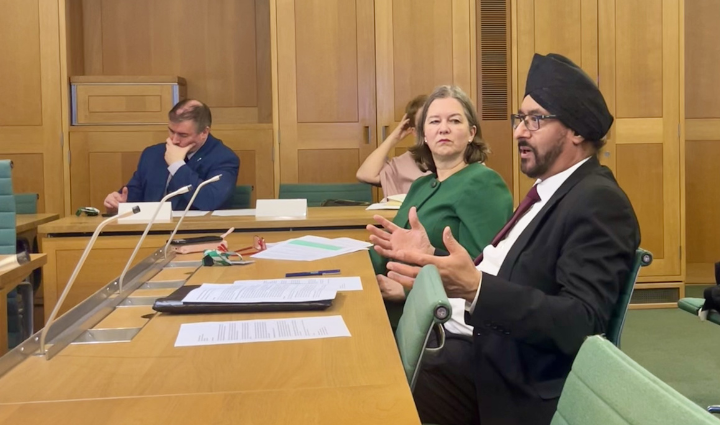
Warinder Juss, Labour MP for Wolverhampton West, highlighted how the plans will hinder integration.
The magnitude of the “earned” settlement policy is hard to convey, not least because the government has not yet released an Impact Assessment. Without this, neither ministers nor the general public can know how the sweeping reforms will affect the economy, public services and communities.
The Department for Health and Social Care recently confirmed that it simply does not know how many NHS workers would be affected. This lack of information casts major doubt on the validity of the government’s consultation.
Building on the momentum of this event, we have been working with Duncan-Jordan and Unison to turn that support into something tangible. We wrote to the Home Secretary, Shabana Mahmood, calling for her to rule out retrospective application of her plans, and to restart the consultation process once a full Impact Assessment and a Child Rights Impact Assessment are released.
Political advocacy can only go so far without collaboration with those set to be hit hardest by parliamentarians’ decision-making. As we move into the next stage of our campaign against “earned” settlement, we will continue to ensure that migrant workers themselves can speak truth to power on their own terms.
If you like our work, please consider making a donation.
Your support helps us keep our legal advice free, and campaign for an immigration system that works for all.